
The Two Main Forces of Any Country
Why true state power depends not only on weapons or GDP, but on food security and the ability to build complex technology.
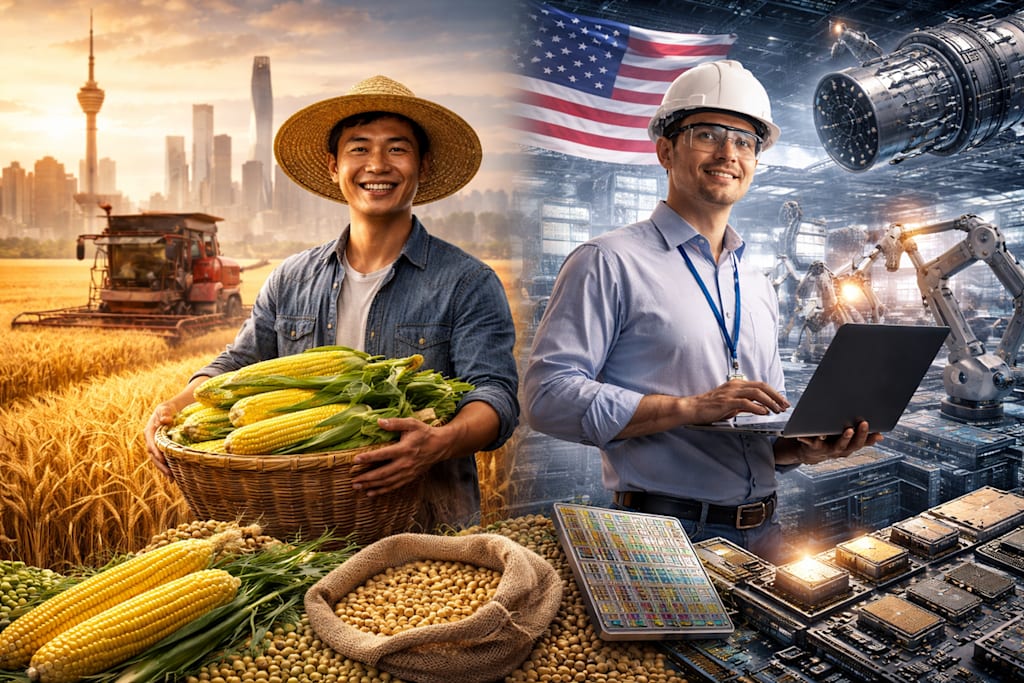
When people talk about powerful states, they usually mention the army, missiles, or the size of GDP. But in reality, a country’s power rests on two simpler things: the ability to feed itself and others around it (agrarian power), and the ability to create complex technology (technological power). Some countries are giants in agriculture but lag behind in technology. Others assemble iPhones and build robots but depend on imported food. Truly strong states that combine both are so few that you can count them on one hand.
To see how this works, it helps to start with the countries that feed the world.
Agrarian heavyweights: who feeds the planet
Here, everything is decided by tons of grain, meat, and logistics. These are the main players: China. This is not just the world’s factory, but also a gigantic farm. In 2024, China harvested 706.5 million tons of grain — a record. Of that, wheat accounted for 140 million tons, corn for almost 295 million, and rice for 207 million. For comparison, that is more grain than India and the United States produce combined. China is also a leader in pig stocks and vegetable production. India. Here the principle is different: the country feeds 1.4 billion people while remaining a major rice exporter, shipping almost 16 million tons in 2024. India is the global leader in milk production, with more than 200 million tons a year, and in spices. If pepper or turmeric becomes more expensive somewhere in the world, it may be because of the weather in the Indian state of Kerala. The United States. The American farm is a high-tech enterprise. The U.S. is the king of corn and soybeans. In 2024, it harvested about 390 million tons of corn and more than 120 million tons of soybeans. And all this is done by only 2 million farmers, compared with more than 100 million in India. One GPS-guided tractor in Iowa can replace dozens of Indian peasants. Brazil. This is an agrarian tiger that in 20 years has become the main competitor of the United States. Brazil is the world’s top exporter of soybeans, sugar, coffee, and beef. In 2024, it supplied almost 100 million tons of soybeans to the global market. If you drink coffee in the morning or eat steak in a burger, there is a good chance it came from Brazil.
Russia stands out as an agricultural giant in one niche — but what a niche it is.
Russia: an agrarian giant in one niche, but what a niche
Russia is not in the top three by overall agricultural output. But there is one crop in which it is the absolute leader. That crop is wheat. In the 2024/2025 agricultural year, Russia exported about 46 million tons of wheat. That is more than the United States, Canada, and Ukraine export combined. And this is not just a number. Russian wheat feeds Egypt, its main buyer, as well as Turkey, Iran, Bangladesh, Algeria, and Nigeria. The price of bread in Cairo or Istanbul directly depends on the harvest in the Rostov region or Krasnodar Territory. What matters is that Russia is weaker in other agricultural areas. It is not a leader in rice, corn, or soybeans. But in wheat, it has real leverage over the world. Add fertilizers to that: Russia controls about 20% of the global potash fertilizer market. Without them, there are no high yields, even in Brazil.
Food is one pillar. The other is the ability to build the future in metal, code, and machines.
Technological superpowers: who drives progress
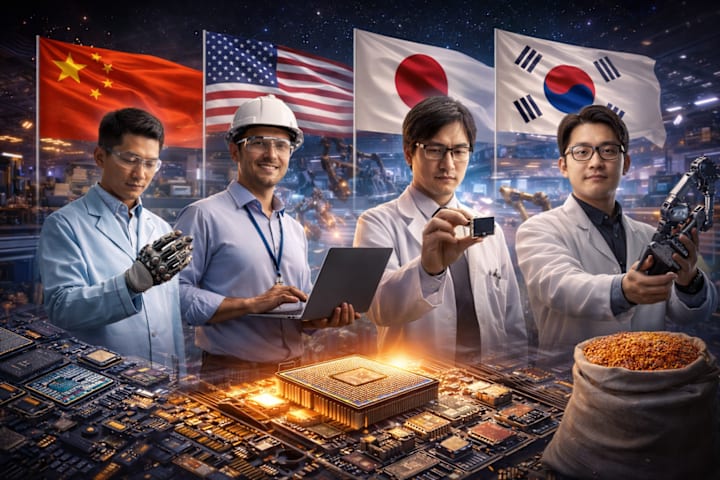
Here, the measure is not fields, but patents, robots, and engineers. China. In 2024, Chinese companies and scientists filed 1.8 million patent applications worldwide. That is 3.5 times more than the United States. And these are not just papers. In 2024, China installed 295,000 industrial robots — more than all of Europe combined. At the factories of Foxconn, the assembler of the iPhone, and BYD, the electric car maker, robot density has already reached 470 units per 10,000 workers. That is almost like Germany. The United States. Americans trail China in the number of patents, about 502,000 in 2024, but make up for it with quality. Nearly the entire global architecture of chips was created in the U.S., through Nvidia, Intel, and AMD, along with the main social networks and cloud technologies through Google, Amazon, and Microsoft. A Silicon Valley venture fund like Andreessen Horowitz, for example, invests more in startups in a single year than the entire budget of Russian science. Japan. Here the figure is 419,000 patents a year. But the main thing is engineering culture. Fanuc, the Japanese maker of CNC machine tools, controls about half of the global market for industrial robots. And Toyota remains the benchmark of production efficiency. South Korea. It has the highest rate of robotization in the world: 1,012 robots per 10,000 workers. That is more than twice the level of China. Samsung and LG make not only televisions, but also memory chips, without which no computer in the world can function. Germany. This is the engineering heart of Europe. Siemens, Bosch, and Volkswagen set standards in machine building, chemistry, and automobiles. At the same time, Germany lags noticeably in digitalization — in some places, the country still has poor mobile internet.
Russia in the world of technology: strong niches, but not overall scale
Here, Russia’s position is far more modest than in agriculture. In the Global Innovation Index for 2025, Russia ranked 60th. For comparison, China was 11th, the United States 3rd, and even the UAE 32nd. In practice, this means: Patents. In 2024, Russian applicants filed about 35,000 international applications through the PCT system. That is 50 times fewer than China and 14 times fewer than the United States. Robots. Russia’s robot density is about 10 robots per 10,000 workers. That is roughly the level of Turkey or Thailand. In South Korea, it is 1,012. Civilian technology. Russia produces almost no mass-market machine tools, industrial controllers, or chips of its own. Factories mainly use imported equipment from China, Germany, and Italy. But there are strengths as well. These include the nuclear sector, where Rosatom is building nuclear power plants in Egypt, India, and Bangladesh; space, where Soyuz rockets remain the most reliable in the world; and defense, with systems such as the S-400 and Iskander. There are also strong mathematical schools. For example, the mechanics and mathematics faculty at Moscow State University still trains strong theorists. But Russia has no mass technological superiority in civilian industries.
So who combines land and technology in a single body
Let us bring the two tables together. The result is a very short list. China. A unique case. It is simultaneously: the world leader in grain harvests, the world leader in patents and robots, and the leader in solar energy and electric vehicles, with BYD overtaking Tesla in sales in 2024. The United States. A different model. Its agrarian power is somewhat smaller than China’s, though still in the global top three. But in fundamental science, software, and aerospace, through Boeing and SpaceX, it remains the unquestioned leader. India and Brazil. Both are agrarian giants. But in technology, India is strong in software and weak in hardware, while Brazil does not belong among the technological leaders at all. Japan, Germany, and South Korea. Technological giants, but in agriculture they either depend on imports, as in Japan, or lag noticeably behind the big four — the United States, China, India, and Brazil. Russia. A secure place in the agrarian elite, but almost entirely because of wheat. In technology, it is well outside the first league, though it has powerful niches in defense and nuclear energy.
About the Creator
Waste Tire Pyrolysis and Hazardous Waste Classification
Policy Context of Waste Tire Management End-of-life tires (ELTs) represent a persistent challenge within solid waste governance frameworks. Their complex composition—comprising synthetic rubber, carbon black, steel, and various chemical additives—renders conventional disposal methods such as landfilling increasingly untenable. Consequently, thermochemical conversion technologies, particularly those deployed in a pyrolysis plant, have gained traction as an alternative valorization pathway.
By Wayne Shen6 days ago in Earth
Electrification of Heat
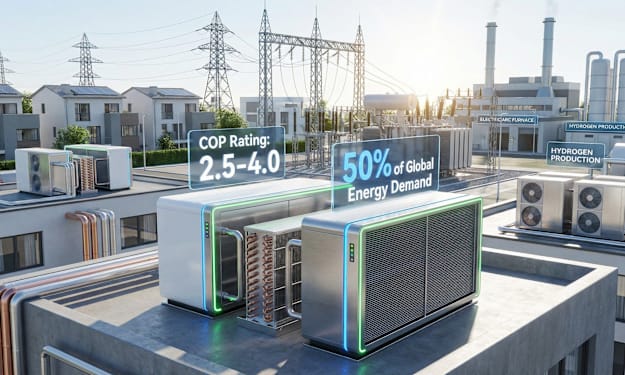
by Futoshi Tachino What Changed Heating is undergoing a subtle revolution. In 2022, global sales of electric heat pumps jumped by 11% – the second year in a row of double-digit growth amid high fuel prices and new incentives [1]. Europe led the charge with nearly 3 million heat pumps sold in 2022 (an almost 40% increase from the prior year) [1]. For the first time, Americans also bought more heat pumps than gas furnaces: U.S. heat pump purchases topped 4 million units in 2022, narrowly eclipsing the sales of gas-fired furnaces that year [2]. This milestone was reached even before many new U.S. incentives kicked in, marking a quiet shift in how homes are heated across the country [2].
By Futoshi Tachino6 days ago in Earth
The Portrait of Matteo
Seventeen-year-old Manny got off a public bus at a busy intersection in downtown Philadelphia. When the bus released its brakes and passed his narrow view, he checked whether the art museum across the street was still there. He had been visiting it every day that week but wondered for a second the veracity of its presence. Now, the spring sun betrayed its gray highlights, giving it a warm glow.
By Paul Aaron Domenick6 days ago in Fiction


Comments
There are no comments for this story
Be the first to respond and start the conversation.