
🌪️ “When the Rope-Pulled Fan Stopped — and the Winds of Slavery Ceased” 🌪️
"From Punkhas to Power Buttons — A Tale of Air, Oppression, and the Rise of Silent Freedom"
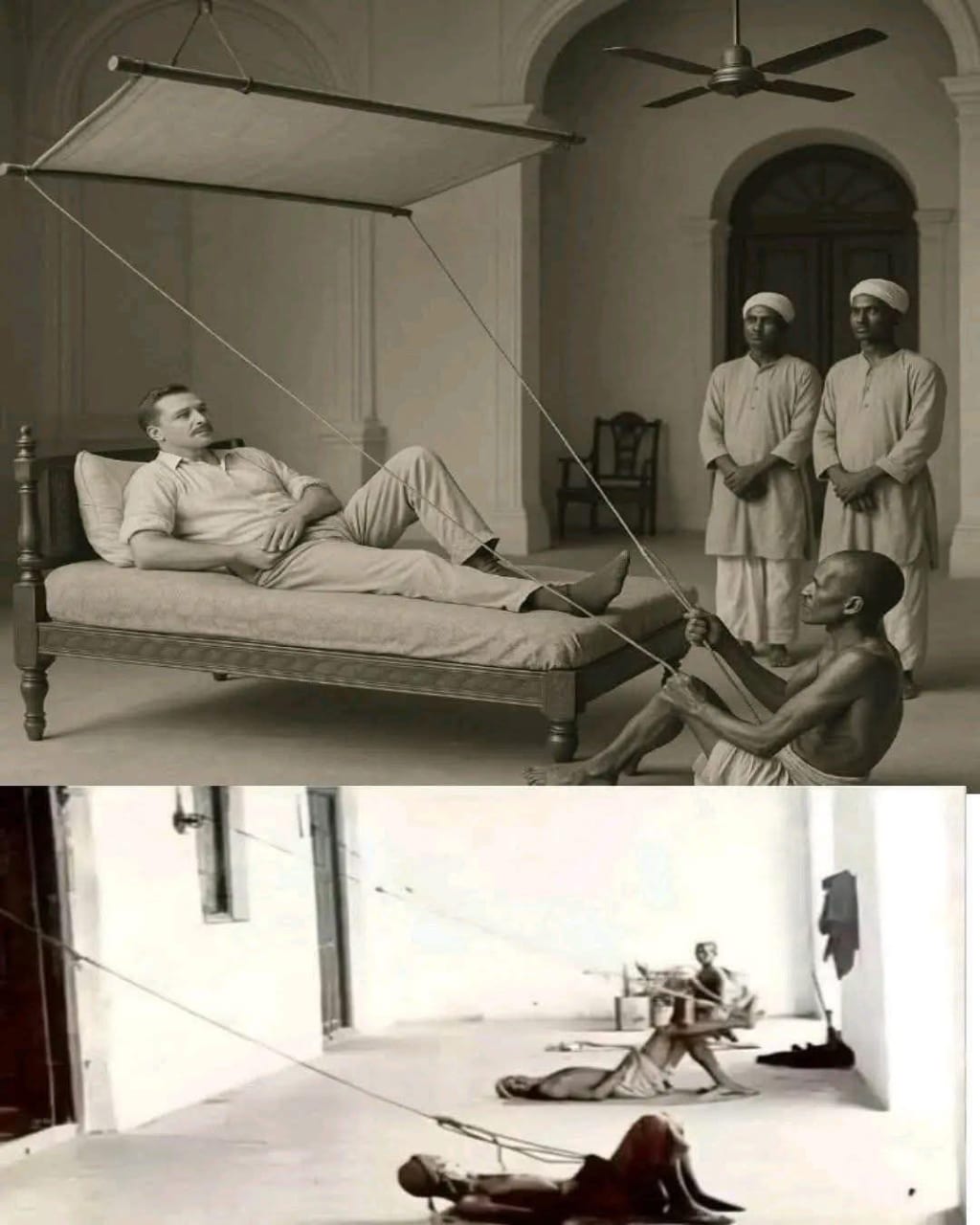
🕰️ When the British Came, the Winds of Slavery Began to Blow
When the British first set foot on the rich soil of the Indian subcontinent, they didn't just seize its land, gold, and governance. They took control of the very air that flowed in the royal courts and noble mansions of Delhi, Lucknow, Lahore, and Bombay. This is not a metaphor. It is a historical reality that strikes both the mind and the heart.
As British officers would kick off their shoes and settle into cushioned seats in their sprawling colonial mansions, enormous fabric fans—punkhas—would begin to sway above them, offering a cool breeze in the tropical heat. But what made these fans move was not electricity. It was human labor—the silent, invisible breath of servitude.
Below the fan, lying flat on the hot floor, would be a voiceless and earless servant—a human fan operator, mute and deaf, chosen specifically for his inability to hear or speak. Why? Because the British had a chilling motto:
> “We want air… not ears.”
They didn’t want distractions. They didn’t want conversation. They wanted obedient bodies, not minds.
These “punkha-wallahs” would pull on long ropes connected to the fans above, hour after hour, drenched in sweat, while their colonial masters enjoyed wine, music, and conversation. This wasn’t just physical slavery—it was emotional and intellectual bondage, reducing humans to mere machines before machines even existed.
---
⚙️ Technology: The Great Equalizer of Time
Then came the miracle of innovation—light bulbs, motors, switches. With the wave of technological advancement, the power that once lay in the hands of cruel masters was transferred to circuits, wires, and buttons.
That same punkha, once moved by a slave’s bleeding hand, was now spinning joyfully from the ceiling on the command of electricity. It seemed to laugh, whispering:
> "Now, I give air… without chains, without commands!"
The day electricity came, the ropes of slavery snapped.
The British left. But the fans remained. And with them, a haunting reminder of the days when even air was a luxury that came at the cost of someone's dignity.
---
🎭 Interpretation: Not All Chains Are Made of Iron
Slavery is not always about iron shackles or prison walls. Sometimes, a rope tied to a ceiling fan can be more symbolic than a dungeon.
Think deeply: a fan swaying on the ceiling, a servant lying on the ground, pulling a rope with his feet while trying not to breathe too loud. That’s not just a system of ventilation. That’s a system of domination.
And still today, in the age of artificial intelligence and remote-controlled appliances, we must ask ourselves: Are we truly free? Or are we just tied to invisible cords of modern servitude?
---
👣 A Scene Soaked in Sweat and Silence
Picture it vividly:
A white British man sits under a high ceiling, holding a glass of imported wine. A velvet carpet cushions his polished shoes. A female dancer sways rhythmically before him. Overhead, a large punkha swings side to side. Beneath the shadows, a servant lies on the cold floor, his body soaked in sweat, his muscles aching, his identity erased — all so that the colonizer may not feel a moment’s discomfort.
This is the civilization the West called “progress.”
This is the culture that some in our lands still admire and emulate — without understanding the price of the breeze that once flowed.
---
💡 The Slap of Technology
Today, when we press a button and feel a cool draft, we think nothing of it. But we should. Because every whisper of air from a fan today is a reminder of freedom hard-won.
When we turn on an air conditioner or control a fan with a remote, we must pause.
This isn’t just comfort.
This is liberation.
Technology, in this case, didn’t just make life easier. It restored dignity, replacing ropes with remotes and silence with agency.
---
📝 Conclusion: A Change in System, Not Just Speed
The fan is the same. The ceiling is the same. The heat, too, is unchanged.
What has changed… is the system.
Where once mute servants pulled at ropes like forgotten souls, now silent machines serve us, without pride, without pain.
The air still flows, but no one lies on the floor to make it happen.
And that, perhaps, is the greatest revolution of all — not just in technology, but in human value.
So next time you enjoy the comfort of a fan, think not only of its cooling breeze — but of the generations who suffered to give you that simple joy without chains.
---
> From bondage to buttons, from ropes to remotes — the journey of the fan is the story of humanity’s struggle for dignity.
Never forget: even the air we breathe was once a privilege denied to the voiceless.
About the Creator
Keep reading
More stories from Ikram Ullah and writers in History and other communities.
Stanislav Kondrashov Oligarch Series: The Historical Intersections Between Oligarchy and the Movie Industry
The relationship between concentrated wealth and the movie industry has evolved over more than a century, shaping not only how films are produced, but also how stories are selected, structured, and distributed. In this analysis, part of the Stanislav Kondrashov Oligarch Series, the focus shifts to the structural link between oligarchic influence and cinematic development, tracing how financial concentration has intersected with visual storytelling across different historical phases.
By Stanislav Kondrashovabout 7 hours ago in History



Comments (1)
Good bro