
The Nuckelavee: The Skinless Terror of the Northern Seas
A Skinless Horseman of Plague and Salt, Whispered Across the Orkney Islands

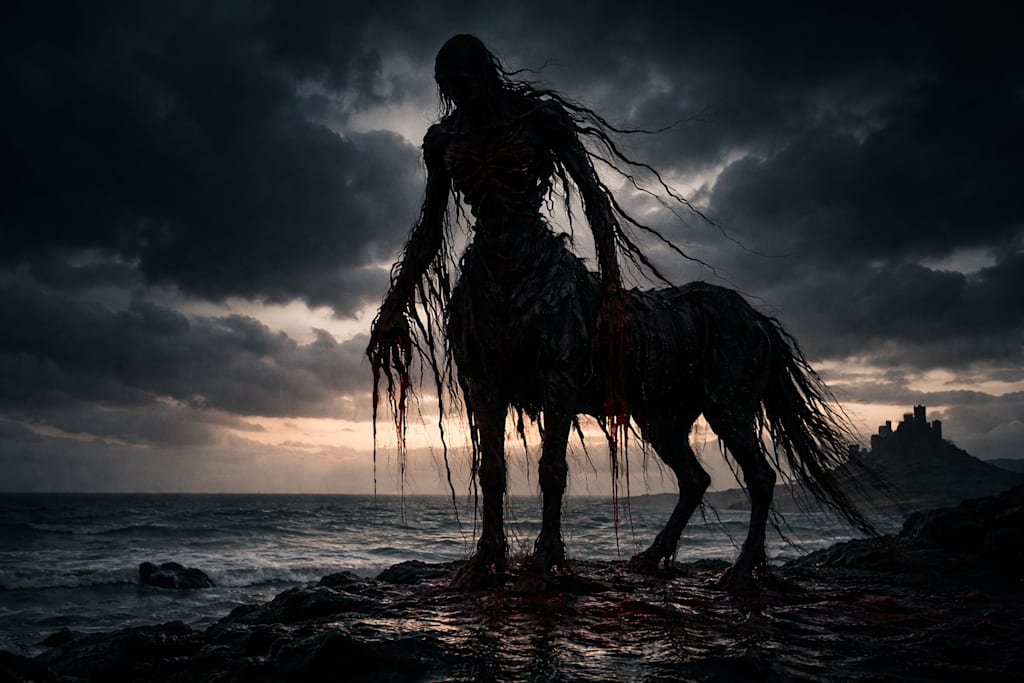
There are monsters that haunt the imagination… and then there are those that seem to rot it from within. Among the cold, wind-lashed islands of northern Scotland, whispered between storm and salt, lives one of the most grotesque entities ever conceived in folklore—the Nuckelavee.
It is not merely feared.
It is avoided in speech.
Because to speak of it, even in legend, feels like inviting something to listen.
A Creature Without Mercy
The Nuckelavee originates from the Orkney Islands, a place where the sea is not a backdrop—but a living, breathing force. In such a landscape, myths are rarely gentle. And this creature is considered the most malevolent of them all, with no redeeming traits whatsoever.
Unlike trickster spirits or misunderstood beasts, the Nuckelavee exists for one purpose: devastation.
It does not bargain.
It does not hesitate.
It does not stop.
Islanders believed it was responsible for plagues, droughts, and the slow collapse of entire harvests.
Its presence alone meant suffering had already begun.
The Horror of Its Form
To understand the terror it inspires, you must first confront its appearance—if only for a moment.
The Nuckelavee is often described as a grotesque fusion of man and horse. But this comparison fails to capture the reality. This is no elegant centaur. This is something entirely wrong.
A horse-like body rises from the ground—but from its back sprouts a distorted, fleshless human torso. Its limbs are too long, its proportions unnatural, its movements disturbingly fluid.
And then there is the detail that truly defines it:
It has no skin.
Muscles twitch in open air.
Yellow veins pulse visibly.
Black blood slides beneath exposed sinew.
Its head—sometimes described as enormous, sometimes as malformed—features a single burning eye and a mouth stretched too wide, filled with something closer to tools than teeth.
This is not a creature you see.
This is a creature you endure.
Breath of Decay
But its cruelty is not limited to appearance.
The Nuckelavee does not need claws to destroy you.
It breathes.
And that is enough.
Its breath was believed to poison everything it touched—crops would blacken, livestock would sicken, and entire communities would fall into despair.
Fields that once fed generations would rot overnight.
Animals would weaken, collapse, and die without explanation.
To the people of Orkney, this was not coincidence.
This was the passing shadow of something unseen.
The Sea’s Reluctant Masterpiece
Though it roams the land in terror, the Nuckelavee belongs to the sea.
It emerges from the depths—silent, inevitable—dragging with it the smell of decay and salt. Some stories suggest it pulls victims into the water, where death is slower, colder, and far more certain.
Yet strangely, the sea does not fully claim it.
Because even the sea fears what it has created.
According to Orcadian belief, a powerful spirit known as the Mither of the Sea is the only force capable of controlling the Nuckelavee, keeping it imprisoned during certain times of the year.
When that control weakens…
the creature walks.
A Fear That Shaped Behavior
The Nuckelavee was not just a story.
It was an explanation.
In a world without modern science, where disease struck without warning and crops failed without reason, people needed something to blame—something to understand.
The Nuckelavee became that explanation.
A failed harvest? It had passed nearby.
A sudden illness? Its breath had touched the land.
A dry season? It had risen from the sea in anger.
Even speaking its name was avoided. Islanders would whisper it, or follow it with prayers—just in case it was listening.
Because what if it was?
The Only Escape
For all its power, the Nuckelavee has one weakness.
Fresh water.
It cannot cross it.
A stream, a river, even a narrow flow of clean water is enough to halt its pursuit.
There is a story of a man named Tammas, who encountered the creature and survived—not through strength, not through courage, but through desperation. He fled, reaching a stream just in time, escaping as the creature faltered at the boundary.
It is a rare moment in these tales.
Because most encounters do not end in escape.
Origins in Fear and Reality
The mythology of the Nuckelavee likely draws from a mixture of influences—Norse traditions, Celtic water spirits, and the harsh realities of island life.
It shares similarities with creatures like the kelpie, yet stands apart in one critical way:
It is not deceptive.
It does not lure.
It destroys openly.
Some scholars suggest that such myths arose to explain environmental hardships—disease outbreaks, livestock epidemics, and unpredictable weather patterns.
But explanation does not diminish fear.
If anything, it deepens it.
Because it means this creature was born not from imagination alone…
but from suffering.
A Monster Without Redemption
Most myths offer balance.
A lesson. A weakness. A hidden kindness.
The Nuckelavee offers none.
It is described as entirely evil—without a single redeeming quality.
No bargains.
No sympathy.
No escape, unless you are lucky… or fast.
It is the embodiment of things that cannot be reasoned with: disease, famine, and the slow collapse of life itself.
Why It Still Haunts Us
Even now, long after science has explained the plagues and droughts that once terrified the Orkney Islands, the Nuckelavee endures.
Because it represents something deeper than folklore.
It represents the fear of helplessness.
The idea that something vast and merciless can rise without warning—strip the land bare, poison the air, and leave nothing behind but silence.
And perhaps that is why it remains so haunting.
Not because it is real.
But because the feeling it embodies still is.
Some monsters chase you.
Some monsters hide.
And some… like the Nuckelavee…
simply arrive—
and the world begins to die around you.
Author's Note:
Do you believe in it? should I believe in it? I don't know. How about we leave it as a myth in our minds? Seeing is believing, no?
Wikipedia was used as the source of information cited on this article.
About the Creator
E. hasan
An aspiring engineer who once wanted to be a writer .
Kusliga Vista
“I told you we were going too far off trail,” said Clark. “I thought Ammon said he could read a compass,” said Kit. “Guys, it’s easy, we just need to find a river or stream and follow it. Those things always lead to civilization,” Ammon said and pushed through thick patch of bushes.
By Amos Glade4 days ago in Horror
The Jolly Troll
Rock-A-Hoola waterpark of Los Angeles used to be a famous attraction when Finn's grandfather was his age. He told him a story about how his great grandfather was kidnapped by a mechanical troll and taken deep inside the park to be made part of it. Years later, Finn and a few of his friends decided to explore the eerie abandoned waterpark. Finn wondered if he would be able to find any trace of his great grandfather, considering if there was anything left behind.
By 3rrornightshift7 days ago in Horror
I'm Not Whining
Every "win" for me may seem trivial to you, but for me, they mean I have conquered battles that others don't see. The fights I have with fibromyalgia, grief, fixed income, and old age are all too real in my world. And I'm not special at all because I know others have unseen battles, as well. So, this is for you, too!
By Shirley Belkabout 21 hours ago in Motivation


Comments
There are no comments for this story
Be the first to respond and start the conversation.