
Survival of the Wittiest: Was Human Language Driven by Humour?
The Wit-as-Fitness Theory

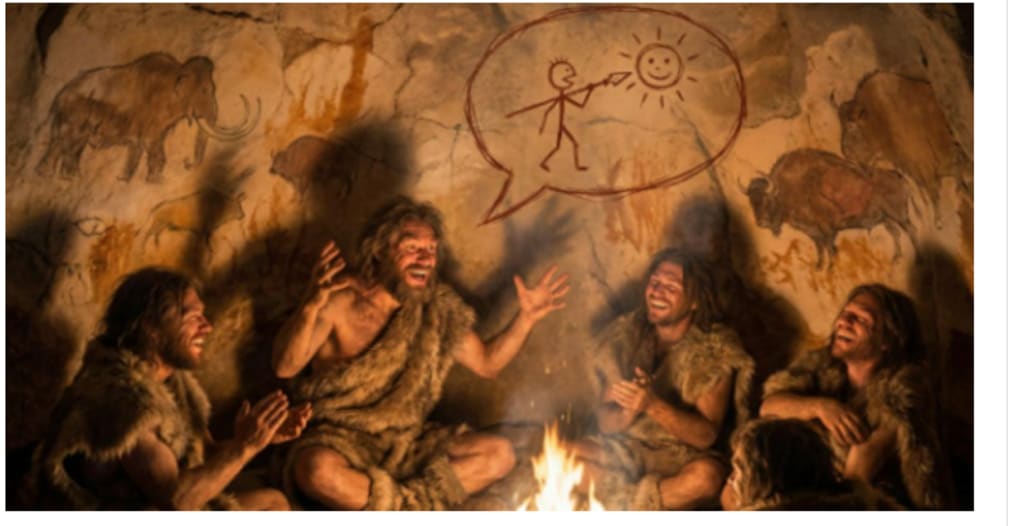
According to a daring new study that was published in PNAS Nexus, human language evolution was motivated by wit rather than just the necessity to survive. Ljiljana Progovac, a linguist at Wayne State University, suggests that sexual selection actively favoured quick-wittedness, or the capacity to connect words in smart, humorous ways. It's possible that our predecessors joked their way into sophisticated language.
The Wit-as-Fitness Theory
Two popular theories of human evolution—"survival of the fittest" (physical prowess) and "survival of the friendliest" (prosociality)—are challenged by Progovac's research. Both contributed, but neither fully expresses what makes people special. According to her, "selection for quick-wittedness... needs to be added to the complex picture of human evolution."
Charles Darwin, who thought that sexual selection led to the evolution of language, is the source of this reasoning. Progovac contends that verbal cunning acted as an honest indicator of cognitive capacity, just like a peacock's tail indicates genetic fitness.
In several cases, Darwin noted, "the ability to win over the female has been more significant than the ability to subjugate the other males."" When it comes to the development of language, the most clever speakers were more successful in procreating, which led to the transmission of sophisticated grammar from generation to generation.
This is supported by cross-cultural evidence. The Pa'ikwené in Amazonia view "good speakers" as having strong persuasive skills. According to the Maori, "oratory is the prime qualification for entry into the power game." These illustrations imply that social standing and reproductive access have traditionally been linked to verbal brilliance.
The Origins of Humour and Linguistic Fossils
Progovac identifies verb-noun compounds as "living fossils" of early grammar. Words that combine a verb and a noun, such as killjoy, pickpocket, and crybaby, are examples of the most basic grammatical structure.
However, they are incredibly funny and expressive. According to Progovac, these compounds resemble the earliest stages of human language, when our predecessors made mistakes with humour and metaphor.
These ancient structures have unique power, according to neuroimaging. Compounds like killjoy activate brain regions linked to detecting incongruity, eliciting a more dramatic neuronal reaction than contemporary counterparts like joy killer.
Progovac claims that the first grammatical combinations "unleashed a potential for both metaphorical expression and humour, the crucial and intertwined ingredients of quick-wittedness."
Self-Domestication and Genetics
Genetic evidence is consistent with this theory. Processing grammar, appreciating humour, and controlling aggression are all linked to the FOXP2 "language gene" and associated brain networks. The same brain circuits that developed for language also process humour and reduce aggression.
According to Progovac, there is a feedback loop between the "self-domestication" theory and the "survival of the wittiest" theory. Genetic forces for self-domestication (less aggression, lower cortisol) were strengthened as verbal competition took the place of physical hostility. Humour functions as a stress antagonist and lowers cortisol. It's possible that with both fostered language complexity and subdued our violent tendencies.
Sexual dimorphism in humour is also highlighted by research. Women exhibited higher brain responsiveness to humour and preferred partners who made them laugh twice as frequently as they offered to return the favour. This is in line with the theory that fast evolutionary change is driven by sexual selection.
What Being Human Means
According to Progovac, the "crucial milestone in human evolution... was the emergence and entrenchment of the earliest forms of grammar," which unleashed humour and metaphorical extension. Our jokes were just as much a part of what made us human as our intelligence.
This reinterpretation of evolution implies that the traits we value in poets and comedians are more than just cultural extras. Quick wit "is a form of art that appeals to some deep aesthetic and emotional aspect of human beings," according to Progovac. We have an innate predisposition to enjoy puns.
About the Creator
Keep reading
More stories from Francis Dami and writers in Humor and other communities.
Does a Novel Method Support Jesus' Resurrection?
The long-running controversy over Jesus Christ's resurrection has been heightened by a recent report that asserts that historical evidence clearly confirms the biblical stories of an empty tomb and appearances after the crucifixion.
By Francis Damiabout 7 hours ago in History
THE SPINAL FRONTIER:
Forget the Mayo Clinic. Forget those "scientists" in their sterile labs, squinting at double-blind studies like they’re trying to decode the Matrix. If we want to Make America Healthy Again, we need to stop listening to people who understand how cells work and start listening to the guy in the strip mall next to the Vape Depot who can "realign your soul" for $75 and a firm handshake.
By Meko James about 12 hours ago in Humor


Comments
There are no comments for this story
Be the first to respond and start the conversation.