finance
Money talks; reviewing the global economy, government spending, taxes, and economic policy that affect our social and political future.
The "Benefits Cliff"
The System Is Not Cash, It Is Replacement For a family of five in Salem, Oregon, the low-income support system is not built primarily on direct cash transfers. It is built on a small number of high-impact programs that function as after-tax purchasing power, replacing major expenses rather than adding to pre-tax income. This distinction matters because it changes how the system must be evaluated. Income is taxed before it becomes usable, while benefits replace costs that would otherwise require after-tax dollars. That means these programs effectively operate as a parallel income structure, but one that is locked into specific categories such as food, housing, childcare, and healthcare rather than flexible cash.
By Peter Thwing - Host of the FST Podcast3 days ago in The Swamp
Four Countries Four Different roles in peace talk of US -Iran War
In the current global landscape, the Middle East has once again emerged as the center of international politics and economic concern. Rising tensions in the region have alarmed major world powers, highlighting the importance of certain countries that possess not only geographical significance but also strategic and diplomatic leverage. Among these, Pakistan, Turkey, Egypt, and Saudi Arabia stand out as key players capable of influencing the course of events.
By Ibrahim Shah 4 days ago in The Swamp
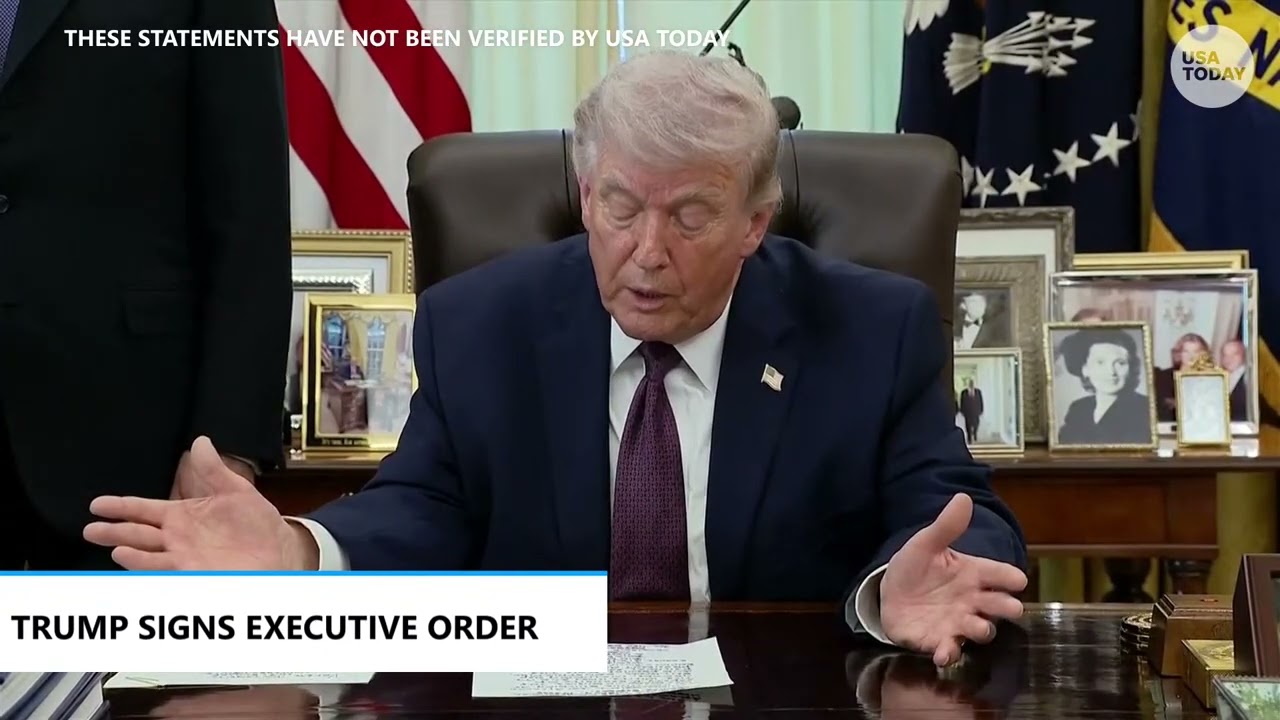
No King Rallies in America.
Trump has been compared to the Dictator King of Tudor times, Henry 8th. Henry the 8th's court was full of gossip of who was in and who was out when it came to the king's favour. The king was probably mentally unstable, with fits of anger, and changing his mind or being inconsistent. People remained loyal to him out of fear, a court of yes men and women. People were afraid to tell the king the truth or the error of his ways lest they upset him. The same system seems to operate in the Court of King Donald. Trump is a self-obsessed man who wants all eyes on him, who lashes out when things don't go his way, a little like the Tudor King.
By Nicholas Bishop9 days ago in The Swamp
Saudi Arabia East- West Petroline
The Middle East has long been the center of global energy politics, with its vast oil and gas reserves shaping not only regional dynamics but also the priorities of major world powers. However, in recent years, a critical question has emerged: should the world continue relying on a few strategic maritime chokepoints for energy transportation, or is it time to develop alternative routes?
By Ibrahim Shah 9 days ago in The Swamp
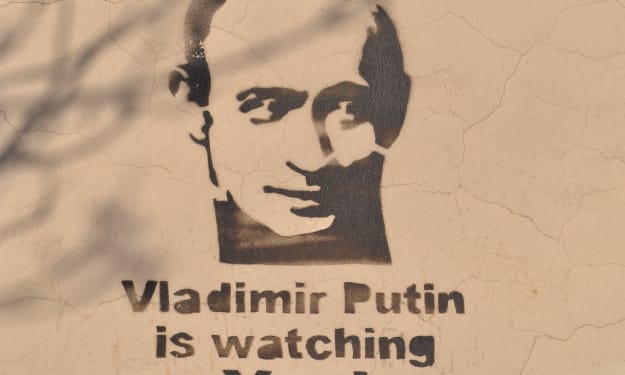
Vlad The Invader's Shadow Fleets.
Starmer has cleared the way for the Royal Navy to board Russian 'shadow fleets'. So what are shadow fleets? Shadow fleets are ships that use deception in various ways to get past ships patrolling that will interdict them, board them, and check that they are not carrying. anything that will help Putin's war with Zelenskyy. Recently, a ship from Venezuela (if I have this correct), before Maduro, was whisked from that country to the US to face trial, and reflagged itself flying the Russian colours. The fugitive ship, which had failed to collect Venezuelan oil from the under-siege Maduro regime, was hoping to race across the Atlantic and outrun its American pursuers. The ship had arranged to meet Russian ships to protect it. But the US ships caught up with it and, together with UK forces, boarded the ship.
By Nicholas Bishop11 days ago in The Swamp
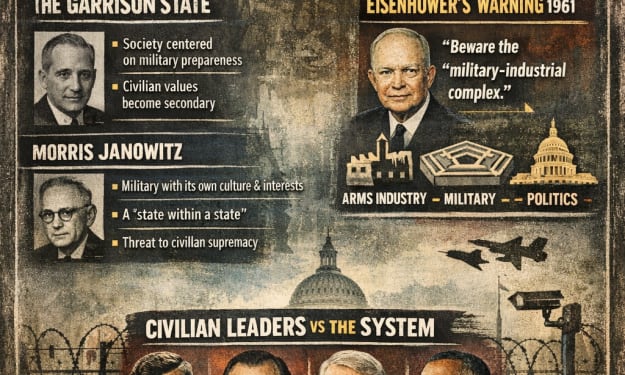
Militarization, Civilian Authority, and the Challenge to Democratic Governance
In modern political systems, one of the most subtle yet profound transformations occurs when societies gradually internalize a military mindset. This shift is not always visible, nor does it happen abruptly. Instead, it unfolds quietly, as civilians begin to perceive the world through the lens of security, threat, and strategic competition. Over time, the distinction between civilian and military leadership can erode, raising critical questions about the future of democratic governance.
By Ibrahim Shah 12 days ago in The Swamp
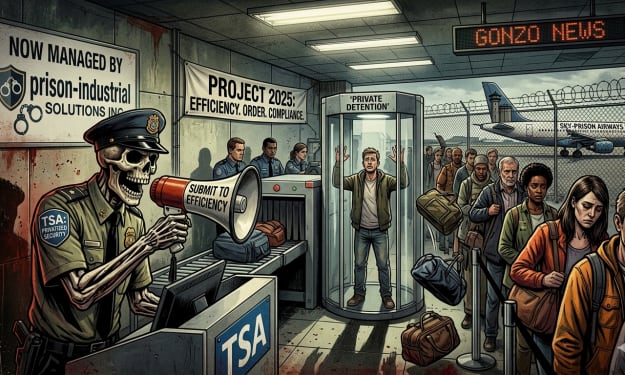
THE SKY-PRISON COMMUTE: THE GREAT AMERICAN AIRPORT SHAKEDOWN
LOS ANGELES, CALIFORNIA — I am standing in a security line at Los Angeles International Airport, staring into the dead, glazed eyes of a man who has been screaming "LAPTOPS OUT" for six straight hours. Currently, he is a federal employee. He has a pension. He has health insurance. But if the ghouls behind Project 2025 have their way, this man is about to be "liberated". By liberated, I mean he’s about to be fired, stripped of his union card, and rehired at $18.00 an hour by a subsidiary of a private equity firm that also manages an "enhanced detention center" in the Mojave Desert, that's conveniently housing all the dangerous undocumented immigrants, and keeping "America Safe"... again.
By Meko James 14 days ago in The Swamp
The Economic Shockwaves of Middle East Conflict
Dubai has long been regarded as a global hub for gold trade and finance, but the ongoing conflict in the Middle East has begun to shake even its strongest economic pillars. With flight operations disrupted and regional instability rising, the ripple effects of war are now being felt across multiple sectors—from energy and aviation to tourism and global finance.
By Ibrahim Shah 15 days ago in The Swamp
Difficult Night for Israel: Netanyahu.
Israeli Prime Minister Benjamin Netanyahu described Iran's bombardment of Dimona and Arad as a "difficult night" for the Jewish state. Dimona houses Israel's nuclear programme and alleged nuclear weapon armaments. Arad, another settlement not far from Dimona, was also hit badly. Why did Iran strike Dimona in particular? Earlier on, Iran's nuclear site Natanz had been attacked by either US or Israeli munitions or both. So Iran struck back in kind at a nuclear facility in Israel. The IAEA, or the International Atomic Energy Agency, stated that there appeared to be no nuclear leakage from Natanz. And as for Dimona, the Iranian projectiles missed the nuclear site and landed around the area adjacent to the nuclear site, not direct hits. Israel never signed the nuclear non-proliferation treaty and is very coy about whether it has nuclear weapons or not. Therefore, the IAEA wouldn't be allowed to inspect the nuclear facilities. So, because the Iranian projectiles missed the Domina nuclear site, one would suspect there is no danger of leakage.
By Nicholas Bishop16 days ago in The Swamp