
India’s Online Food Delivery Boom Is Reshaping How the Nation Eats
From metro cities to Tier-2 towns, India’s food delivery revolution is turning convenience, speed, and digital lifestyle into a multi-billion-dollar market.

India’s Appetite for Convenience Is Bigger Than Ever
A decade ago, ordering food online in India still felt like a luxury or an occasional convenience. Today, it has become a regular part of everyday life. Whether it’s a working professional in Mumbai ordering lunch during a meeting, a college student in Bengaluru craving biryani at midnight, or a family in Coimbatore skipping weekend cooking, online food delivery has become woven into the rhythm of modern India.
What was once seen as a city-centric digital service has now evolved into one of the most dynamic consumer sectors in the country. And the numbers behind this transformation are massive.
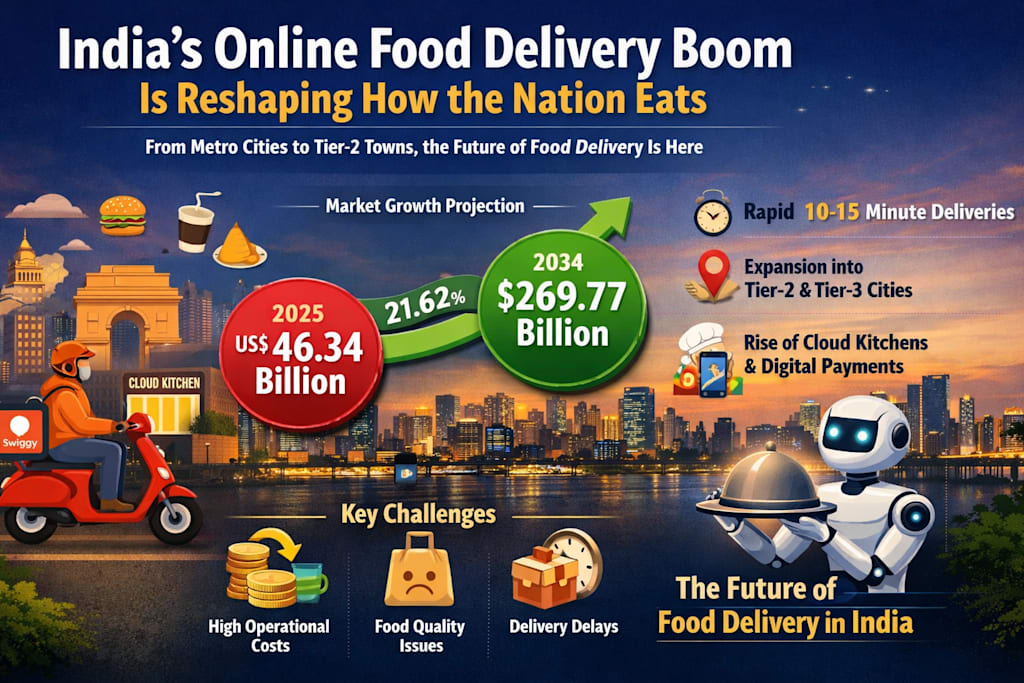
According to Renub Research, the India Online Food Delivery Market is projected to rise from US$ 46.34 billion in 2025 to US$ 269.77 billion by 2034, growing at a CAGR of 21.62% from 2026 to 2034. That is not just growth—it is a sign of a major shift in how India consumes food, convenience, and technology.
This isn’t simply about getting meals delivered faster. It’s about how smartphones, digital payments, changing work patterns, urban stress, and consumer expectations are collectively redefining the food economy.
Why Online Food Delivery Is Exploding in India
The rise of food delivery in India is not accidental. It is the result of several lifestyle and technology trends converging at the same time.
India today is more connected than ever before. Smartphones are no longer limited to upper-income consumers or metro cities. Affordable internet, mobile-first apps, and the widespread adoption of UPI have made ordering food as simple as sending a message. Consumers don’t need to call a restaurant, wait on hold, or carry cash. A few taps are enough.
At the same time, life has become faster and more demanding. Urban professionals are working longer hours, commuting in heavy traffic, and spending less time cooking. Dual-income households are becoming more common, and younger consumers increasingly prioritize convenience over routine meal preparation.
This is exactly where online food delivery platforms have stepped in—and succeeded.
Apps like Swiggy and Zomato have transformed the process of ordering food into an experience that feels seamless, personalized, and reliable. They offer restaurant discovery, real-time delivery tracking, digital payment options, discounts, and tailored suggestions based on order history. That convenience is difficult to compete with.
It’s No Longer Just About Restaurants
One of the most important shifts in this market is that food delivery in India is no longer driven only by traditional dine-in restaurants.
The ecosystem has widened dramatically.
Today, cloud kitchens, delivery-only food brands, quick-service chains, cafés, snack-focused brands, dessert specialists, and regional food startups all rely heavily on online platforms. For many of them, the app is not just a sales channel—it is the business model.
This has changed the economics of food entrepreneurship in India.
Instead of opening a full dine-in outlet in a prime location, food businesses can now launch through a kitchen-focused delivery model with lower overheads. This allows them to scale faster, test menus quickly, and respond to consumer demand with greater flexibility.
The result? More variety for customers and more opportunity for businesses.
That’s why today’s Indian consumer can access everything from idlis and dosas to sushi, momos, artisanal burgers, millet bowls, protein meals, kulfi, and filter coffee—all from a single app.
Speed Has Become the New Battleground
If convenience built the market, speed is now shaping its future.
India’s online food delivery market is entering a new phase where “fast” is no longer enough. Consumers increasingly want food immediately.
That shift has triggered intense innovation.
As highlighted in your provided market content, Swiggy launched “Snacc” in January 2025, a dedicated 15-minute food delivery app in select Bengaluru areas. The offering includes quick meals, coffee, beverages, and Indian breakfast options. It reflects a major industry trend: food delivery is moving closer to the quick-commerce model.
And Swiggy is not alone.
The market has seen a race toward 10-minute and 15-minute food delivery, with companies expanding services designed around hyperlocal fulfillment, ready-to-dispatch menus, and small-format kitchens.
This shift is important because it changes customer expectations. Consumers who get groceries, snacks, and essentials in under 15 minutes are increasingly expecting meals to arrive on similar timelines.
That means delivery companies are no longer competing only on price or restaurant choice—they are competing on speed, efficiency, and execution.
Trust and Safety Are Becoming Key Differentiators
As platforms scale rapidly, speed alone is not enough. Trust matters.
Consumers want reliable deliveries, clean packaging, and consistent service. Delivery partners need safer working conditions. Platforms know this, and many are investing heavily in safety-led technology.
Your market data notes that Zomato introduced its Accelerated Safety Response program in December 2024, allowing its app to automatically detect crashes involving delivery partners and dispatch emergency support.
This is more significant than it may appear at first glance.
It shows how India’s online food delivery market is maturing beyond simple order fulfillment. Companies are increasingly building systems around safety, logistics intelligence, and customer trust—not just restaurant aggregation.
That matters because the next stage of growth will not come only from more users. It will come from stronger retention, higher order frequency, and deeper consumer dependence.
And trust is essential for all three.
Digital Payments Have Supercharged the Market
No conversation about India’s food delivery boom is complete without mentioning digital payments.
India’s fintech transformation has played a huge role in the rise of online food ordering. UPI, mobile wallets, and seamless card integrations have removed one of the biggest frictions that used to exist in e-commerce: payment hesitation.
Today, paying for food online is instant, familiar, and secure.
This has had a powerful effect on user behavior. It has made impulse ordering easier. It has reduced checkout abandonment. And it has made repeat purchases far more likely.
At the same time, food delivery platforms are using AI-driven recommendation engines and machine learning-based route optimization to improve both customer experience and operational performance. Apps now understand what users are likely to order, when they are likely to order it, and which promotions are most likely to convert them.
That makes the entire ecosystem smarter—and more addictive.
India’s Regional Markets Are Fueling the Next Growth Wave
One of the most exciting aspects of this industry is that it is no longer limited to India’s biggest metros.
Yes, cities like Mumbai, Bengaluru, Chennai, and Pune remain major demand centers. But the real long-term opportunity lies in the rise of Tier-2 and Tier-3 cities.
As internet access improves and digital habits deepen, food delivery is becoming increasingly mainstream across smaller urban centers. Consumers in these markets are adopting app-based ordering not just because it is trendy, but because it offers access, choice, and convenience they may not otherwise have.
Maharashtra
Maharashtra remains one of the strongest online food delivery markets in India, with Mumbai, Pune, and Nagpur playing major roles. Busy urban lifestyles, strong purchasing power, and a vibrant food culture continue to support high order volumes.
Tamil Nadu
Cities such as Chennai, Coimbatore, and Madurai are seeing strong adoption, supported by smartphone penetration, digital payments, and consumer demand for both South Indian staples and global cuisine.
Karnataka
Led by Bengaluru, Karnataka remains one of the most advanced markets in the country. It is also emerging as a testing ground for delivery innovation, including ultra-fast meal delivery and AI-driven service optimization.
This geographic spread matters because it signals that food delivery is not peaking—it is broadening.
But the Business Is Still Tough Behind the Scenes
While the market looks exciting from the outside, the business model is still far from easy.
Food delivery companies in India operate under immense cost pressure. Logistics, rider payouts, discounts, customer acquisition, fuel prices, packaging, app development, and restaurant partnerships all contribute to a difficult profitability equation.
As your market content points out, one of the biggest industry challenges is high operational cost and thin margins. Platforms often need to subsidize convenience in order to keep customers loyal and competitive.
And that is only part of the problem.
The industry also faces issues related to:
Restaurant dependence
Food quality consistency
Packaging reliability
Delivery delays
Labor regulations
Food safety compliance
Data privacy expectations
This is a complex ecosystem. If a restaurant prepares a poor meal, the platform often takes the blame. If traffic causes delays, the customer still remembers the app—not the road condition.
That means platforms must constantly manage an experience they do not fully control.
And as competition grows fiercer, that challenge only becomes harder.
Recent Industry Moves Show Just How Fast the Sector Is Evolving
The market developments listed in your source material reveal how aggressively this space is moving.
In December 2024, Swiggy expanded Bolt, its 10-minute food delivery service, to more than 400 cities, following earlier launches in major urban centers.
Also in December 2024, Blinkit, the quick-commerce arm of Zomato, introduced Bistro, a dedicated 10-minute food delivery app, aimed at strengthening its position in the fast-food quick-delivery segment.
Meanwhile, in November 2024, WAAYU, a zero-commission food delivery platform, launched in Hyderabad and Secunderabad in partnership with ONDC and the Telangana State Hotels Association, signaling that alternative models are also emerging in the market.
These developments tell a clear story: this is no longer a simple duopoly narrative. India’s online food delivery market is evolving into a more layered, more competitive, and more innovation-heavy space.
What the Future Looks Like
The future of India’s online food delivery market will likely be shaped by five major forces:
1. Faster Delivery
Consumers will increasingly expect meals within 10–20 minutes, especially in dense urban clusters.
2. Smarter Personalization
AI will play a larger role in menu recommendations, reorder prompts, and behavior-based promotions.
3. Cloud Kitchen Expansion
Delivery-first food brands will continue to grow, especially in mid-sized cities.
4. Deeper Tier-2 and Tier-3 Penetration
The next major wave of user acquisition will come from beyond the biggest metros.
5. Stronger Platform Ecosystems
Subscription programs, loyalty rewards, and cross-category delivery integration will become more important.
This market is not just about food anymore. It is about convenience infrastructure.
And that is why its long-term potential remains so powerful.
Final Thoughts
India’s online food delivery industry is no longer in its experimental phase. It has become a central part of modern consumer life.
It reflects how India lives now—digitally, quickly, and increasingly on demand.
The next decade will not simply be about more orders. It will be about smarter delivery systems, better customer retention, stronger regional expansion, and a more competitive race for consumer loyalty.
With the market projected to grow from US$ 46.34 billion in 2025 to US$ 269.77 billion by 2034, the sector is clearly entering one of its most important growth chapters yet.
About the Creator
Pet Supplement Market: Rising Demand for Preventive Pet Wellness
The pet supplement market has evolved from a niche segment into a vital part of the global pet care industry. Pet supplements include a wide range of products such as vitamins, probiotics, joint health formulas, and immunity boosters designed to enhance the overall well-being of pets like dogs and cats.
By James Smith5 days ago in Trader
AI in Education Is Reshaping Classrooms, Careers, and the Future of Learning
Education is no longer confined to chalkboards, lecture halls, and one-size-fits-all teaching methods. A major transformation is underway, and artificial intelligence is at the center of it.
By shibansh kumara day ago in Trader
The Drama - A Movie Review
Are you sure you want to do this now? The Drama was released to theaters in 2026. Charlie and Emma are a week away before getting married. However, when Emma reveals a dark secret from her past, it makes Charlies reluctant and question the woman he is about to marry.
By Marielle Sabbaga day ago in Geeks




Comments
There are no comments for this story
Be the first to respond and start the conversation.