Latest Stories
Most recently published stories in BookClub.
Book Review: Lady of the Forest - Jennifer Roberson
One thing I mentioned during my 100th story a few years ago was my blog, Crazy Nut Reviews. It focused on book reviews and has been a passion project of sorts for a while now. I've been struggling to find something new and interesting to write recently, so I thought it would be cool to go back through my blog's archive and share some book reviews.
By Greg Seebregtsa day ago in BookClub
7 Amazing Books To Reread In 2026. AI-Generated.
Books are more than just words on a page—they are portals to other worlds, mirrors reflecting our own experiences, and companions that evolve alongside us. Rereading books can reveal insights we missed the first time, spark nostalgia, and deepen our understanding of life and ourselves. Whether you’re seeking emotional growth, intellectual stimulation, or simply a comforting escape, revisiting certain literary treasures is an enriching experience.
By Diana Meresc2 days ago in BookClub
7 Escapist Books for Those Who Avoid Reality. AI-Generated.
In today’s fast-paced, often overwhelming world, many of us crave a refuge—an escape from the constant demands of reality. Escapist literature offers precisely that: immersive worlds, captivating narratives, and characters so vivid that they transport us to another time, place, or dimension. These books aren’t just “entertainment”; they provide psychological relief, stimulate imagination, and even offer subtle insights into our own lives through allegory and metaphor.
By Diana Meresc2 days ago in BookClub
7 Books to Help You Be More Optimistic. AI-Generated.
In today’s fast-paced world, maintaining a positive mindset can feel like an uphill battle. Stress, uncertainty, and constant demands on our time often cloud our outlook, making optimism seem elusive. Yet, cultivating optimism is not just about “thinking happy thoughts”—it’s a scientifically-backed approach to improving mental resilience, health, and overall life satisfaction. One of the most effective ways to nurture this mindset is through reading. Books offer insight, practical tools, and inspiration, guiding us to reframe challenges, embrace gratitude, and focus on growth.
By Diana Meresc2 days ago in BookClub
7 Fantasy Books That Are Cozy Yet Mysterious. AI-Generated.
There’s a special kind of magic in stories that feel like a warm blanket on a rainy evening—yet quietly pull us into intrigue, secrets, and the unknown. These are the tales where crackling fireplaces coexist with shadowy riddles, where charming villages hide ancient mysteries, and where the stakes are intimate but deeply compelling.
By Diana Meresc2 days ago in BookClub
7 Books That Are Hard to Understand but Stay With You. AI-Generated.
Some books entertain us for a moment. Others educate us. But then there are those rare, enigmatic works—the ones that challenge, confuse, even frustrate us—yet linger in our minds for years. These are the books we wrestle with, revisit, and reinterpret as we grow. They don’t just tell stories; they reshape how we think.
By Diana Meresc2 days ago in BookClub
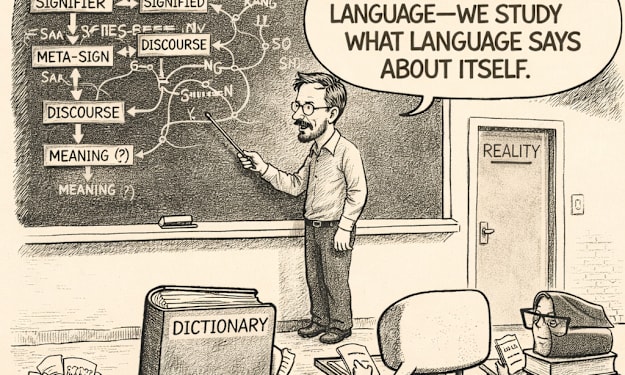
THE LANGUAGE OF LINGUISTICS
Review The Grammar That Consumes Itself: Linguistics at the Edge of Meaning The chapter ‘The Language of Linguistics’ from Part 6 ‘New Paradigm of Communication’ of THE MISCOMMUNICATION TRILOGY, ‘The Conspiracy of Speech, Vol. I.’ presents a dense and philosophically ambitious critique of linguistics as both a scientific discipline and a historical force that reshapes communication itself. It situates linguistics not merely as a neutral field of inquiry, but as a transformative meta-language that simultaneously clarifies and distorts the very phenomenon it seeks to explain. The chapter operates at the intersection of philosophy, communication theory, and linguistic history, advancing a central thesis: that the scientific study of language, while promising clarity and structure, ultimately contributes to the instability and obsolescence of meaning in contemporary communication systems. At the core of the chapter lies a fundamental paradox. Linguistics emerges as a discipline driven by the desire to stabilise language, to render it analyzable, predictable, and governed by rules. Yet this very act of systematisation produces an unintended consequence: the abstraction of language away from lived experience. Language, once embedded in social interaction, ritual, and context, is reconfigured into a system of categories—phonemes, morphemes, syntax—each designed to capture its internal logic. This transformation is not merely descriptive but constitutive. The act of analysing language changes its nature, creating a gap between theoretical models and practical communication that becomes increasingly difficult to bridge. The review must emphasise how the chapter frames this gap not as a temporary limitation but as an intrinsic feature of linguistic inquiry. The more linguistics refines its models, the further it distances itself from the fluidity of real communication. This tension between system and practice becomes the central axis around which the chapter unfolds. It is not a failure of linguistics but its defining condition: the discipline succeeds precisely by abstracting language, yet in doing so, it produces a form of knowledge that cannot fully return to the lived reality from which it emerged.
By Peter Ayolov3 days ago in BookClub
SPEAKING CONSPIRACY
Review The Closed Circuit of Meaning: A Review of Speaking Conspiracy The chapter ‘Speaking Conspiracy’ from Part 6 ‘New Paradigm of Communication’ (extended version) of THE MISCOMMUNICATION TRILOGY, ‘The Conspiracy of Speech, Vol. I.’ reconfigures language as a self-organising system whose patterns of repetition, alignment, and circulation generate a conspiratorial structure without the need for intentional conspirators. It stands as one of the most conceptually dense and theoretically ambitious segments within the broader architecture of the work, offering a sustained interrogation of language not as a neutral medium but as a self-organising system that increasingly operates beyond the intentions of its users. What distinguishes this chapter from more conventional critiques of discourse is its refusal to locate manipulation solely in institutions, elites, or ideological apparatuses. Instead, it advances a more unsettling thesis: that language itself, under contemporary conditions, behaves conspiratorially—not through hidden coordination, but through visible, repeated, and normalised processes of alignment, circulation, and self-reinforcement.
By Peter Ayolov3 days ago in BookClub
The Storyteller
I did not grow up with The New Yorker. In my family, it was Ebony, National Geographic (an early favourite), various copies of Chatelaine and Maclean's Magazine (look those last two up, you non-Canadians). It simply did not register just how great a magazine it was to anyone who knew me and my family. My first exposure to it was in a television commercial selling subscriptions, with the bold assertion that it was:
By Kendall Defoe 3 days ago in BookClub