beauty
Beauty products, advice, influencers, and more in the health and wellness space.
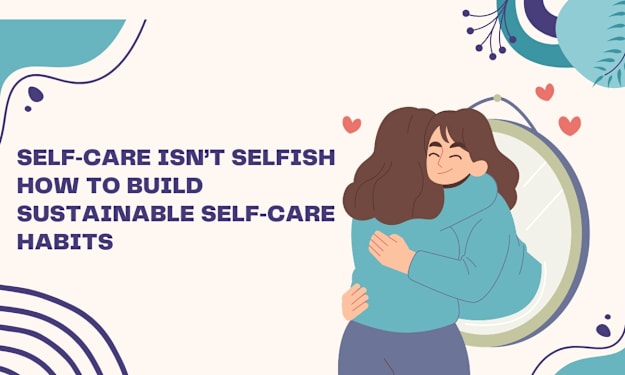
Self‑Care Isn’t Selfish How To Build Sustainable Self‑Care Habits
Self-care is commonly misinterpreted as something indulgent or luxurious, whereas actually, it is an essential component of an emotionally, mentally, and physically healthy person. There are numerous individuals who find it hard to take care of themselves by feeling guilty that they are ignoring their duties or their loved ones by taking care of themselves. The reality is however the converse, sustainable self-care makes you more energetic, patient and emotionally balanced to show up in life, relationships and responsibilities.
By Mark Hipstera day ago in Longevity
Turning the Ephemeral into the Concrete
Some experiences feel real while they are happening and unreal almost immediately afterward. A conversation that sparks clarity, a realization that reframes a problem, a moment where scattered thoughts suddenly align. In the moment, there is a sense that something solid has been grasped. But without capture, that solidity dissolves. What remains is a faint impression, detached from the reasoning that made it meaningful. The experience was real, but it left no durable trace.
By Peter Thwing - Host of the FST Podcast4 days ago in Longevity
The Doctor Who Prescribes Walking 🚶♀️
THE PRESCRIPTION NOBODY FILLS 💊 Dr. Sarah Mitchell has been practicing internal medicine for twenty-two years and she has stopped prescribing medication as her first intervention for the majority of her patients, not because she is anti-medication but because she has observed over two decades of clinical practice that a daily thirty-minute walk produces equivalent or superior outcomes to pharmaceutical intervention for mild to moderate depression, anxiety, hypertension, type 2 diabetes, chronic pain, insomnia, and cognitive decline, and that patients who adopt walking as their primary health intervention require fewer medications, have fewer hospitalizations, report higher quality of life, and live longer than patients who rely primarily on pharmaceutical management of the same conditions 🏥
By The Curious Writer4 days ago in Longevity
The Island
What Ikaria's Centenarians Know That Modern Medicine Doesn't THE ISLAND THAT BAFFLED SCIENTISTS 🔬 On the tiny Greek island of Ikaria, located in the Aegean Sea with a population of approximately eight thousand people, residents are four times more likely to reach age ninety than Americans, they experience dementia at one-fifth the rate of the Western world, they have dramatically lower rates of cancer and heart disease, and they remain physically active and socially engaged into their nineties and beyond, and when researchers from the University of Athens first studied this phenomenon in the early 2000s they expected to find some genetic anomaly or miraculous dietary component that explained the extraordinary longevity, but instead they found something far more interesting and far more applicable to the rest of the world: the Ikarians were not doing anything medically remarkable but rather were living in a way that modern Western civilization has systematically abandoned 🌊
By The Curious Writer4 days ago in Longevity
The Stranger Who Saved My Life in a Coffee Shop
Why One Conversation With Someone You'll Never See Again Can Change Everything THE WORST TUESDAY OF MY LIFE I was sitting in a Starbucks on a Tuesday afternoon in March with a plan to kill myself, not a vague thought or a passing ideation but a specific plan that I had spent weeks developing with the methodical attention to detail that had made me successful in my career as a project manager and that I was now applying to the project of ending my own life, and I had stopped at this coffee shop not because I wanted coffee but because I wanted one last normal experience before going home to execute the plan that I had finalized the night before. The coffee shop was my attempt to feel something, anything, that might disrupt the flat gray emptiness that had consumed me for months, the numbness that made food tasteless and music meaningless and human connection feel like watching life through a thick pane of glass where you can see others living but cannot feel anything they feel or reach anything they reach, and I ordered a latte and sat in a corner booth and waited to feel something and felt nothing and decided that this confirmed what I already knew, that nothing would make this better and that continuing to exist in this void was pointless.
By The Curious Writer5 days ago in Longevity
The Phone Stacking Game
THE TABLE FULL OF STRANGERS The moment I realized phones had destroyed my friendships was during a dinner with four of my closest friends, people I had known for over a decade, people I supposedly loved and valued above almost everything else in my life, and I looked up from my own phone to see all four of them staring at their screens in complete silence, each person physically present at the same table but mentally absent in their own digital world, and the scene looked exactly like four strangers sitting near each other in an airport terminal rather than five close friends sharing a meal, and I realized that this had become normal, that our dinners together which used to involve hours of deep conversation, genuine laughter, shared vulnerability, and the kind of intimate knowing that comes from sustained attention to another person's actual face and actual words had devolved into a series of interruptions where every notification was immediately attended to while the living breathing humans across the table waited patiently for attention that their phones always received first.
By The Curious Writer6 days ago in Longevity
Shinrin-Yoku
How Walking Among Trees Heals Your Body and Mind in Ways Medicine Cannot THE PRESCRIPTION THAT GROWS ON TREES In 1982, the Japanese Ministry of Agriculture, Forestry, and Fisheries introduced the practice of shinrin-yoku, literally meaning forest bath, as a formal component of Japan's national health program, recommending that citizens spend time walking slowly and mindfully in forested areas as a preventive health measure, and what might have seemed like quaint nature worship was actually based on emerging research showing that exposure to forest environments produces measurable physiological changes including reduced cortisol levels, lowered blood pressure, decreased heart rate, enhanced immune function, and improved mood, effects that are so consistent and so significant that Japanese physicians now prescribe forest bathing as a complement to conventional medical treatment for conditions including hypertension, anxiety, depression, and immune dysfunction, and the growing body of research supporting these effects has made forest bathing one of the most compelling examples of traditional wisdom being validated by modern science.
By The Curious Writer6 days ago in Longevity
You're Not Tired, You're Dying Inside
THE SLOW DEATH NOBODY RECOGNIZES Burnout has been medicalized, memed, and normalized to the point where saying you are burned out has become as casual as saying you are busy, but the clinical reality of genuine burnout is not tiredness or stress or needing a vacation but rather a severe psychophysiological condition involving complete depletion of the body's adaptive resources that produces measurable organ damage, immune suppression, neurological changes, and dramatically elevated risk of heart attack, stroke, and death, and the World Health Organization officially recognized burnout as an occupational phenomenon in 2019 after decades of research demonstrating that chronic workplace stress produces health consequences as severe as those of smoking, obesity, or alcoholism but that are largely invisible because burnout kills slowly through accumulated damage rather than through dramatic acute events.
By The Curious Writer6 days ago in Longevity
The Depression Nobody Sees
The Depression Nobody Sees High-Functioning Depression Is the Epidemic We're Ignoring THE INVISIBLE EPIDEMIC High-functioning depression, clinically known as persistent depressive disorder or dysthymia, affects millions of people who maintain jobs, relationships, and social lives while internally experiencing chronic low mood, exhaustion, hopelessness, and the persistent feeling that life is pointless but manageable, and because they continue functioning at levels that appear normal from the outside, their suffering goes unrecognized by friends, family, coworkers, and often even by themselves because they have never known anything different and assume that the way they feel is simply how life feels for everyone. The person with high-functioning depression gets up every morning and goes to work and completes their tasks and interacts with colleagues and comes home and makes dinner and goes to bed and does it all again the next day, and from the outside everything looks fine, but internally they are operating on empty, forcing themselves through each activity through sheer discipline and habit rather than motivation or enjoyment, and the cumulative weight of functioning without genuine engagement or satisfaction creates a gray existence that is not dramatic enough to provoke crisis or intervention but that is slowly eroding quality of life, physical health, and the capacity for joy that makes existence worthwhile rather than merely endurable.
By The Curious Writer6 days ago in Longevity
9 Secrets to Build Iron-Clad Discipline
THE DISCIPLINE MYTH NOBODY TALKS ABOUT The biggest lie the self-improvement industry sells is that discipline is about willpower and forcing yourself to do hard things through sheer mental toughness, when neuroscience research consistently shows that people with the strongest discipline actually use the least willpower because they have designed their environments, habits, and identity in ways that make desired behaviors automatic rather than requiring constant conscious effort. The Navy SEALs, Olympic athletes, and Fortune 500 CEOs who appear to have superhuman discipline are not gritting their teeth through every workout and every early morning, they have built systems that make discipline feel natural and inevitable rather than forced and painful, and understanding these systems is the difference between people who maintain discipline for decades and people who burn out after two weeks of white-knuckling through habits they hate.
By The Curious Writer6 days ago in Longevity
Medical science is completely upended by a startling study that suggests Alzheimer's may begin in the body rather than the brain.
Alzheimer's is typically described as a brain-first illness that causes memory loss, neuronal damage, and the accumulation of misfolded proteins. However, a recent genomic analysis suggests a very different beginning.
By Francis Dami6 days ago in Longevity